
(if you want to just play the chess sim, jump to the bottom)
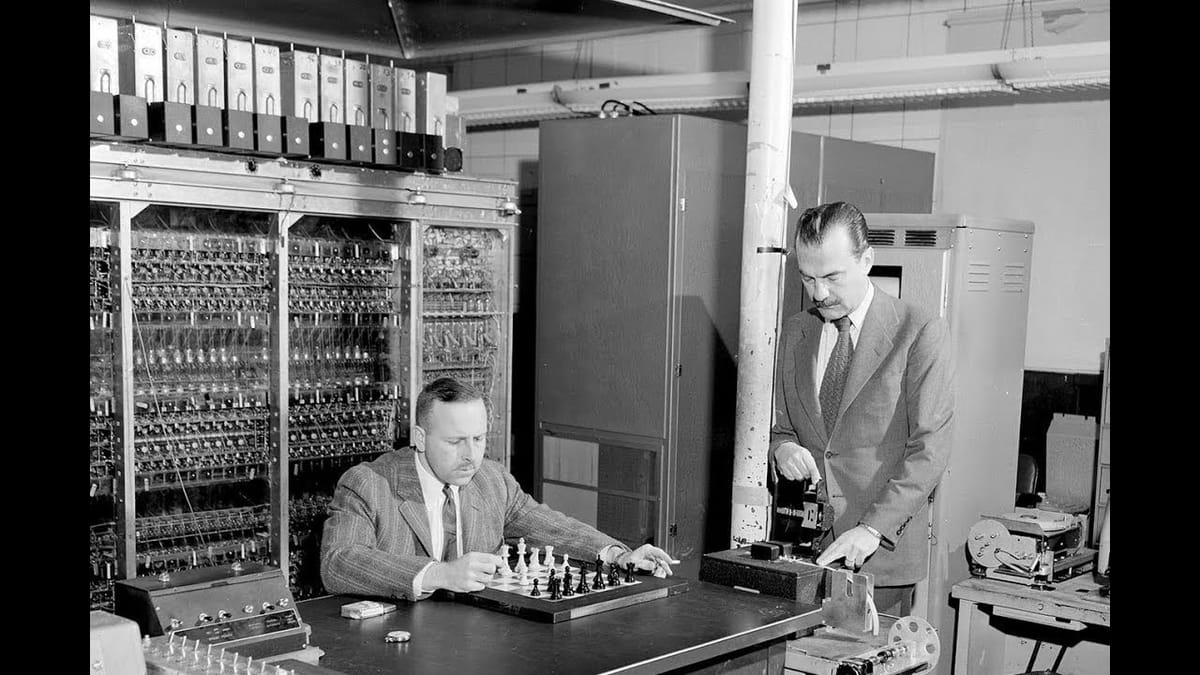
Many thought the name Maniac was appropriate for Jon Von Neuman's computer. This was one of the first computers built in the late 50's and early 60's in the post war era when the nuclear bomb was on everyone's minds and the military wanted to know more.
Von Neumann, a Hungarian-American mathematician who had already contributed to quantum mechanics, game theory, and nuclear physics. In 1945, von Neumann joined the team at the Institute for Advanced Study (IAS) in Princeton, where he laid out the blueprint for a general-purpose digital computer.
That leads us to the Los Alamos Scientific Laboratory, where the atomic bomb had been designed, they quickly realized they needed such a machine to do the complex simulations that had been done by hand. Nicholas Metropolis, one of von Neumann’s colleagues, led the effort. The result was theMathematical Analyzer, Numerical Integrator, and Computer—better known by its cheeky acronym: MANIAC.
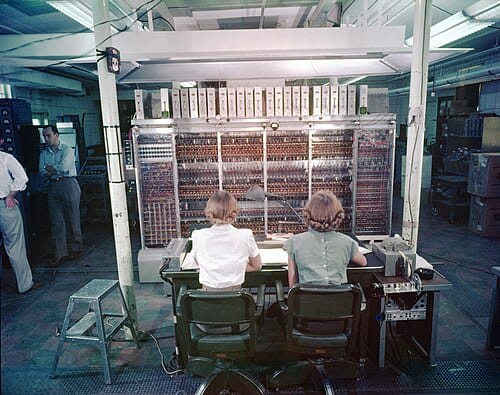
Completed in 1952, MANIAC was among the earliest stored-program computers. It weighed 1,000 pounds and had several thousand tubes. Its purpose was serious: to calculate the implosion dynamics of nuclear weapons, simulate thermonuclear reactions, and eventually to model problems in physics, chemistry, and weather. Its arrival meant Los Alamos could move beyond slide rules and hand-wired calculators into the true digital age.
The Chessboard Story
For all its weighty tasks, MANIAC also became famous for a lighter moment: the chessboard match. In the early 1950s, one of von Neumann’s assistants played MANIAC in a simplified version of chess on a 6×6 board. This was decades before Deep Blue or AlphaZero—long before machines could master the full game. She lost (to be fair she had just learned chess a week before.
It was the first recorded victory of a computer over a human in any chess-like contest. The story was a curiosity and a warning: if machines could already defeat their makers in a game of logic, what else might they accomplish (sound familiar?)
MANIAC I was powerful for its time but still extremely limited - as a side project researchers Paul Stein, Mark Wells, Stanislaw Ulam, William Walden and others wrote a chess‐playing program in 1956 that played a variant of chess called Los Alamos Chess. Here are the key rules:
- Played on a 6×6 board instead of the standard 8×8.
- No bishops. That is, bishops were simply omitted from the set of pieces. The other pieces (king, queen, rooks, knights, pawns) are present.
- Pawns cannot make a double‐step move on their first move.
- No en passant captures.
- No castling.
- Pawns may not be promoted to bishops (since bishops are omitted).
The program was about 600 insturcitons of machine code, and could take minutes to think about a move.
The simulation I built is on google's Gemini and is true to the first public application. I plays the same, but a whole lot quicker. Have fun.
Build Notes
I built this in Google AI Studio - started with a few physical examples, dalton's ball normal curve demonstrations, pachinko, things like that. I had to modify these ideas, since I wanted as close to a random sim as possible. Next problem was that most vibe coding tools don't do well at full 3D physics demonstrations. So a real 3d ball bouncing down, adding colored dots along the way became a headache.
I finally came up with the idea of having the simulation imagine an actual 3d sphere in it's head, and add colored dots in the correct positions as it bounced down and only do a true 3D representation of this at the very bottom - so, a compromise but worked.
The math behind it was straight forward - that is if you let the ai do it - I just had to keep tweaking the ball diameter, the dot diameter, the number of colors and the spacing and number of rows to get a decent 'improbable' number.
Then I had to deploy the app - which Ghost makes pretty easy as an iframe.
PS that's a midjourney image - I got inspired by it to order a bunch of black Onyx spheres to make my own real marbles.